


April sees the new tax year begin alongside the Easter period, bringing fresh attention to tax, succession and estate planning. From the introduction of Making Tax Digital for Income Tax to growing concern over upcoming pension inheritance tax changes, rising IHT receipts and continued delays in will-making, the overall picture is one of increasing complexity and a stronger need for early preparation.
The cases featured in this edition also show how easily uncertainty can develop into conflict when documents are unclear, outdated or poorly structured. Disputes involving homemade wills, trust property, late-life estate arrangements, and financial provision claims all serve as a reminder that careful drafting and regular review remain essential, particularly as family lives and asset structures become more complicated.
In this April edition of the Clarke & Wright newsletter, we examine the latest legal and tax developments affecting individuals, families and business owners, and consider what they may mean in practice.
Cost, complacency and family concerns behind will-writing delay
Cost, complacency and concerns about family disputes are among the main reasons people delay making a will, according to new research, prompting warnings of an emerging “inheritance timebomb”.
The study found that almost three in five people aged 45 to 54 do not have a will, while cost remains a major barrier to writing or updating one. Nearly half of the respondents also said they worry that an outdated or missing will could lead to family disputes.
Legal professionals report a rise in contested estates in recent years, often linked to unequal provision between children, blended family dynamics, DIY wills, poorly drafted wills, or no will at all.
Modern families are changing quickly, but the legal documents meant to protect them are not always kept up to date, increasing the risk of confusion, conflict and disputes after death.
The research also found that inertia plays a significant role, with many saying they have simply never got around to making a will. Regular reviews, experts warn, are an important part of protecting loved ones and helping to avoid unnecessary conflict.
Most adults are still unaware of the pensions IHT change due in 2027
The study found that almost nine in ten adults have little or no awareness of the reforms, which from April 2027 will bring most unused pension funds and death benefits into a person’s taxable estate. The changes are expected to increase the number of estates paying inheritance tax and leave many more facing larger bills.
The impact is likely to be felt most immediately by Generation X, who are often the group most involved in supporting older relatives and handling intergenerational wealth. Yet the research suggests understanding remains limited, with only a small proportion saying they have a good grasp of how inheritance tax works.
The findings also point to the broader effects of frozen tax thresholds, rising property prices, and investment growth, all of which are expected to draw more families into the inheritance tax net over time.
The research underscores the growing need for clear advice and forward planning, particularly as more families may find themselves facing inheritance tax despite not considering themselves especially wealthy.

IHT receipts continue to rise as fiscal drag bites
Inheritance tax receipts continue to climb, with the latest HMRC figures showing £7.7 billion collected between April 2025 and February 2026, £0.1 billion more than in the same period a year earlier.
Commentators said the rise will come as little surprise to private client practitioners, pointing to frozen nil-rate bands, rising property values and wider asset inflation as key drivers. The figures already exceed the full-year total for 2023/24, with one month of the tax year still remaining.
The increase is also set against a backdrop of wider reform, including changes to agricultural and business property relief from April 2026 and the planned inclusion of most unused pension wealth within the IHT regime from 2027.
Advisers warn that inheritance tax is no longer an issue affecting only the very wealthiest. More families with relatively ordinary levels of wealth are being drawn into charge, often without realising it until it is too late for effective planning.
The figures are likely to reinforce calls for earlier estate planning, with growing emphasis on taking a broader view of family wealth, including property, pensions and other assets.
Great Wealth Transfer already underway, STEP says
The long-anticipated Great Wealth Transfer is no longer a future trend but is already happening, according to a new report from STEP.
In its first barometer report, STEP said most practitioners are already seeing wealth pass from Baby Boomers to younger generations, with 77% of those surveyed reporting evidence of this shift. The transfer is expected to involve trillions in global assets over the coming decades.
The report also highlights the growing challenges this transfer is creating for advisers. Blended families, stepchildren, and cross-border family arrangements were identified as among the most common sources of legal and succession-planning difficulties, while disputes often arise between children or stepchildren and a surviving parent or stepparent.
STEP also found rising concern around financial abuse involving vulnerable people, particularly where adult children are involved, as well as increasing demand for capacity-related planning linked to dementia.
The report suggests that practitioners are cautiously embracing AI, with many already using it in their work, but it warns that poor advice from unregulated sources, including online influencers, can increase the risk of disputes, family conflict and invalid wills.
STEP said the report is intended to provide regular insight into the priorities, pressures and changing landscape facing trust and estate practitioners.
Making Tax Digital for Income Tax is now in force
From 6 April, sole traders and landlords with qualifying income over £50,000 must comply with Making Tax Digital for Income Tax. This means keeping digital records, using compatible software, submitting quarterly updates and completing a final declaration after the end of the tax year. The threshold is due to fall to £30,000 from April 2027.
This marks one of the biggest changes to personal tax reporting in recent years. For those affected, the focus now is on making sure systems and record-keeping processes are fit for purpose. While quarterly updates are not payment deadlines, they do require more regular administration throughout the year.
For businesses and landlords that have traditionally handled year-end bookkeeping, the move to a fully digital process may prove challenging without the right support and preparation.
For more details, readers can find further guidance on our associated firm, Mercian Accountants’ website.

Shelter awarded Sean Hughes’ £4m estate after a will dispute
The High Court has ruled that comedian Sean Hughes’ £4 million estate should pass to the housing charity Shelter, almost 10 years after his death, following a dispute over the wording of a homemade will.
Hughes died in 2017, leaving three properties to Shelter, but uncertainty arose because only one was owned by him personally, while the other two were held through a company of which he was the sole shareholder. The court was therefore asked to determine whether those company-owned properties were also intended to pass to the charity.
The judge concluded that the will should be interpreted so that the shares in the company, and therefore the two additional properties, pass to Shelter. Had the court decided otherwise, those assets would have fallen into the residuary estate for the wider family.
The case highlights the risks of homemade wills and the delays that can arise where wording is unclear, even where those involved agree on the deceased’s likely intentions.
Lonan O’Herlihy loses £5m claim against £38m estate
Reality TV star and personal trainer Lonan O’Herlihy has lost his claim for £5 million from the £38 million estate of Hugh Taylor, after the High Court ruled the case had no realistic prospect of success.
Mr O’Herlihy had argued that Hugh Taylor, his mother’s former partner, had acted as a father figure during his childhood and continued to support him financially into early adulthood. He asked the court for reasonable financial provision from the estate and sought permission to bring the claim out of time, saying he had lacked the knowledge and means to pursue it within the usual deadline.
The court accepted there was a real prospect that Mr Taylor had treated Mr O’Herlihy as a son or stepson for a period of time. However, the judge found there was no real prospect of establishing that Mr Taylor still had any obligation or responsibility towards him at the time of his death in 2019.
The judge also rejected the argument that Mr O’Herlihy’s financial needs should be assessed by reference to the high standard of living he had once enjoyed, noting that any support from Mr Taylor had ended years earlier. By the time of Mr Taylor’s death, the court found that Mr O’Herlihy had long been living independently and was capable of earning his own living.
The claim was dismissed, and Mr O’Herlihy was ordered to make an interim payment towards legal costs.
Widow brings £5m fight over property investor’s estate
The widow of London property investor and restaurateur Abbas Moaven is involved in a £5 million High Court dispute over four properties she says should be restored to his estate for the benefit of her and their two children.
Mr Moaven died in 2012, aged 45, leaving his estate in equal shares to his widow, Gabriela Teixeira, and their children. However, after his death, Ms Teixeira discovered documents stating that four properties were not owned solely by him, but were instead shared with his mother and brother.
Ms Teixeira argues that these declarations were not genuine and were intended to prevent her and the children from inheriting the full value of the assets. The court heard that, if the documents are upheld, the estate could be reduced to little or nothing.
The case has been described as a bitter family dispute, with Mr Moaven’s brother maintaining that the documents reflected a long-standing ownership arrangement between the family members.
Commenting on the case, one legal expert said it highlights the serious consequences that can follow from estate planning documents signed in the final weeks of life, particularly when they remove substantial assets from an estate and alter who ultimately benefits.
Judgment has been reserved.
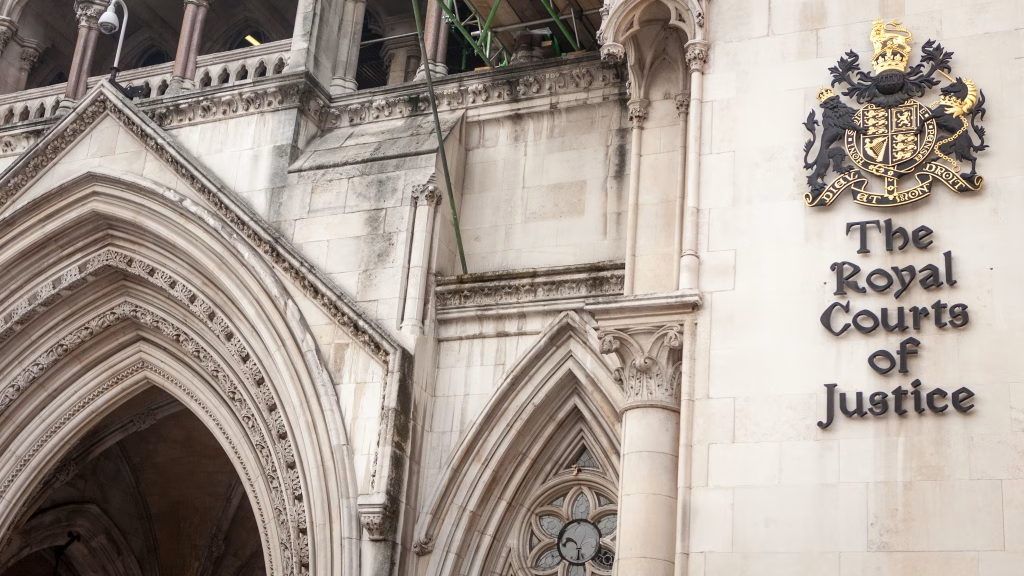
High Court to decide trust dispute over Sir Benjamin Slade’s estate home
The High Court is being asked to decide whether a cottage on Sir Benjamin Slade’s Somerset estate can be sold for the benefit of his former wife, Lady Pauline Slade, under the terms of a long-standing divorce trust.
Lady Slade is the beneficiary of a trust established following the couple’s 1994 divorce, which includes an income fund and the property known as Old Farm. She has now moved out of the house and wants the trustees to sell it, using the proceeds to increase her income and clear debts.
Sir Benjamin is opposing the move, arguing that the property was placed in trust solely to provide Lady Slade with a home for life, not as an asset to be sold for income. His case is that she had only a right to live there rent-free and no entitlement to the sale proceeds unless another property was to be bought as a replacement home.
The trustees have taken a neutral position and asked the court to determine whether Lady Slade can require a sale and, if so, how any proceeds may be used.
The case highlights how trust and property arrangements made on divorce can still lead to significant disputes many years later, particularly where the original purpose of the trust is contested.
Judgment has been reserved.
Farming succession planning remains critical for family businesses
For farming families, the consequences of dying without a valid will can be especially serious, putting not only personal wealth at risk but also the future of the farming operation itself.
Agricultural estates often involve land, equipment, water rights, business structures and informal family arrangements that can be difficult to untangle without clear planning. Because many of these assets are illiquid, families may be forced to sell or engage in disputes simply to settle the estate or provide for heirs.
Succession planning is particularly important in this context. Questions around who will run the farm, how non-farming family members will be treated fairly, and how the business can continue without disruption all require careful thought and proper documentation.
Estate planning for farming families should form part of a broader financial strategy, alongside insurance, tax planning, investment planning, and business structuring. Regular reviews are also important, particularly where family circumstances, legislation or the farming business itself have changed.
The overall message is clear: for family farming businesses, a valid and up-to-date will is a key part of protecting both the family and the farm’s long-term future.
Digital assets and the growing liquidity challenge in estate administration
As more wealth is held online, estate administration is becoming increasingly complex. Digital assets, including cryptocurrency and other online holdings, can add significant value to an estate, but they do not always provide readily available cash when it is needed.
This can create a particular problem where inheritance tax is due before probate is granted. Because tax is assessed on the value of the estate at the date of death, executors may face a situation in which an estate appears valuable on paper but lacks the liquidity needed to meet immediate liabilities.
Digital assets can be especially difficult in this regard, as they may be volatile, hard to access or slow to realise. Alongside property, business interests and investment portfolios, they can leave estates asset-rich but cash-poor at a critical stage in the administration process.
This highlights the need for practical funding solutions that can help bridge this gap, allowing executors to address inheritance tax and administration costs while wider estate assets are accessed or realised. It also underlines the importance of clear record-keeping and secure storage of digital information, so that executors are better able to identify and manage online assets when the time comes.

A timely reminder to keep plans under review
Taken together, this month’s stories point to the same underlying message: good planning is rarely static. Tax rules change, asset values rise, family circumstances evolve, and documents that once seemed clear can become less effective over time.
Recent cases have also shown the cost of uncertainty, whether through litigation, delay or unintended outcomes. Clear advice, properly prepared documents, and periodic reviews remain the best way to reduce the risk of disagreement and ensure that intentions are carried through.
As more families find themselves affected by inheritance tax, pension reform and wider succession issues, this is a good moment to revisit existing plans. A well-structured and up-to-date estate plan can help provide certainty now and reassurance for the future. Please contact our team if you require assistance.