


August tends to arrive quietly. This year it has not. A new Prime Minister has taken office with pointed remarks about inheritance tax. IHT receipts have risen again. And the courts have produced a TV psychic, a threatening letter to solicitors using language we cannot reproduce here, and a High Court battle over a promise made across a kitchen table. A quarter of over-55s have also never once discussed inheritance with their family. If that includes you, this month’s newsletter might prompt a useful conversation.
August In Numbers
- £2.3 billion – IHT receipts in April-June 2026, up £96 million year on year
- £79,800+ – the average annual cost of a UK nursing home place
- 83% – of people who say they know they need a valid will but have not yet acted
- 47% – of homeowners who say they are “just getting by” financially, yet have estates above the IHT threshold
- 1 in 4 – over-55s have never discussed inheritance with their family
Reader Question
Every month, we pick one question submitted by a reader. If you have something you would like us to cover, send it to and it may be featured next month.
“My mother is 84, and we are starting to think about whether she might need residential care in the next few years. Her house is worth quite a lot, and we are worried everything will be swallowed up in fees. Is there anything we can do to protect her estate?”
Patricia, Darlington
Our Answer
Thank you, Patricia. This concern comes up in almost every conversation we have with families in your position. The short answer is that there are options, but the earlier you explore them, the more of them remain open.
Care fees in England are means-tested. Your mother will be expected to fund her own care while her assets, including her home in most circumstances, remain above £23,250. Council support only begins once assets fall below that threshold, and even then a tariff contribution is expected until savings drop below £14,250. Two things are worth knowing alongside this. First, some people qualify for NHS Continuing Healthcare, which covers the full cost of care with no means test at all – we cover this in more detail further on in this newsletter. Second, the structure of any existing will and financial arrangements can make a real difference to what passes to the next generation.
We would caution against making any rushed decisions about transferring property or assets without advice. Arrangements that appear to protect an estate may be treated by the local authority as deliberate deprivation of assets if care is needed within a certain period.
We are glad to talk this through at no obligation, including at home if that is more convenient. Get in touch here.
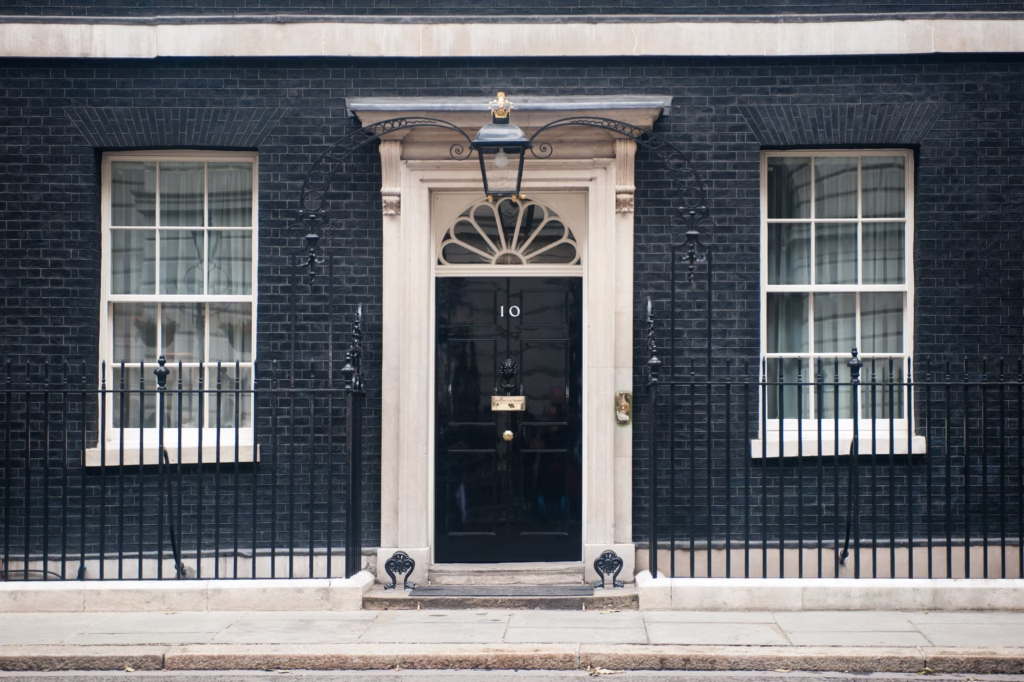
A New Prime Minister: What It Could Mean for Your Estate
Andy Burnham’s arrival in Downing Street has generated considerable commentary in the estate planning world, and not without reason. While he has committed to the existing fiscal framework and the 2024 Labour manifesto pledges on income tax, VAT and National Insurance, several areas of speculation are directly relevant to anyone planning an estate.
that Burnham has previously expressed a willingness to see inheritance tax abolished altogether, on the condition that wealth is taxed more effectively during a person’s lifetime rather than only at death. He has also been reported as prepared to “look again” at the April 2026 restrictions on agricultural and business property relief, which capped previously unlimited 100% relief at £2.5 million of combined qualifying assets.
Two further areas are under active discussion: a potential replacement of inheritance tax with a flat-rate social care levy on estates, and possible alignment of capital gains tax rates with income tax. Neither is confirmed policy. , has noted the uncertainty and advised against making significant changes to existing arrangements until policy direction becomes clearer.
The practical message for families is one of watchfulness rather than panic. The April 2027 pension IHT changes remain on course and are law. The nil-rate band freeze to 2031 is unchanged. What may shift is the longer-term landscape, and the uncertainty itself is a reason to get advice now, while the current rules are known quantities.
IHT Receipts Rise Again: The Freeze Is Still Biting
IHT receipts for April to June 2026 reached £2.3 billion, up £96 million on the same period last year. The nil-rate band has been frozen at £325,000 since 2009 and is now set to remain at that level until 2031.
As , frozen thresholds and rising asset values continue to pull more ordinary estates into the inheritance tax net. HMRC’s own projections indicate that receipts will reach £14.5 billion by 2030/31.
The April 2027 pension changes are not yet reflected in these figures. When they are, the trajectory will steepen further. IHT planning is no longer just for those with very large estates.
Care Costs Are a Bigger Fear Than IHT, and the NHS May Owe You Money
found that over-55s rank paying for care and later-life costs as their single biggest financial concern, ahead of inheritance tax, running out of money in retirement, and family disputes. Only 41% believe their current arrangements would minimise their IHT liability.
The concern is well founded. Average UK care home costs now exceed £73,000 a year. The means test threshold has been frozen at £23,250 since 2010, now entering its sixteenth consecutive year unchanged. Many families are unaware, however, that there is a route that eliminates care fees entirely: NHS Continuing Healthcare, a non-means-tested benefit that covers the full cost of care for those whose primary needs are health-related rather than social.
A case reported this month illustrates what can be lost without that knowledge. after their aunt, known as Ms B, paid privately for care between 2015 and 2020, even though she was eligible for NHS Continuing Healthcare throughout that period. Her entire savings were depleted, and more than half the equity in her flat was used before the family pursued a claim.
As the family’s solicitors noted: “This case shows what families can lose when not given the right information at the right time.” If a family member is currently in care and paying privately, it is worth asking whether they have been assessed for NHS Continuing Healthcare. If you would like to discuss this,

The Conversation a Quarter of Families Are Still Not Having
found that one in four over-55s has never discussed inheritance with their family. Among those aged 45 to 54, the figure rises to 35%. In London, 44% have never had the conversation.
The knowledge gaps behind that silence are striking. Only 15% of over-55s are aware of both the nil-rate band and the residence nil-rate band. Just 35% know that pensions may become subject to inheritance tax from April 2027. Yet 83% recognise the importance of having a valid will, and 61% are aware of the seven-year gifting rule.
The picture is one of people who understand, in broad terms, that estate planning matters, but have not yet translated that understanding into action or conversation. Delayed conversations leave families unprepared, create uncertainty about intentions, increase the risk of disputes, and lead to avoidable delays in estate administration.
The conversation does not need to be formal or comprehensive. It simply needs to happen.
Half of “Just Getting By” Homeowners Are Above the IHT Threshold
found that 47% described themselves as “just getting by” financially, yet the average estate value was £410,252, comfortably above the £325,000 nil-rate band. Thirty-eight per cent have estates above £500,000. Thirteen per cent have estates above £1 million.
Only one in ten women with estates above £500,000 has calculated their IHT exposure. The gap between financial self-perception and actual estate value is, in many cases, explained by property: homes bought decades ago at modest prices have appreciated far beyond what owners expected or feel.
If you have not calculated your potential IHT liability recently, the starting point is simpler than most people expect.

When DNA Tests Rewrite the Family Tree
Genealogy specialists are currently handling a growing number of cases in which home DNA tests have complicated inheritance claims. AncestryDNA now holds 27 million profiles. MyHeritage holds 9.7 million.
According to experts, the problem is not the technology itself but the weight people place on it: “People assume the results they receive from an online test are final, but they’re often inconclusive.” Different databases yield different results from identical DNA. Tests designed to identify broad ancestry are being used as evidence of specific biological relationships in legal proceedings where they are, at best, one piece of a more complex picture.
The practical consequences are already emerging. Tests are uncovering donor conception, unknown relatives, and family secrets hidden for decades. Where those discoveries touch on a will or an estate, the disputes that follow are rarely straightforward.
As Professor Turi King, who led the DNA identification of King Richard III, has noted: “DNA is incredibly powerful, but it’s one piece of evidence, and it always needs to be considered alongside documentary research.”
If a DNA discovery has raised questions about your own family’s inheritance arrangements, we are here to help you think through the implications.
From the Courts: Three Cases Worth Knowing
1. TV Psychic Issued With £216,000 Costs Order
Gary Pammen challenged his late father Terrance’s 2016 will, which left the family home and all assets to Gary’s daughter and granddaughter, making no provision for Gary or two of his siblings. He alleged his father lacked testamentary capacity.
The court was not persuaded. The judge heard that Terrance had been diagnosed with dementia in 2020 but had shown no memory decline until 2017-2018, continued working at Morrisons supermarket until around 2019, and was described by witnesses as “totally sharp” and “independent-minded.” The claim was found to be “based upon no more than suspicion borne out of a family disagreement.”
Gary was ordered to pay £216,013 in costs, with £150,000 payable immediately. A capacity challenge requires robust medical and contemporaneous evidence. Unsuccessful claims carry devastating cost consequences.
2. Lambert v Lambert: When a Promise Is Not Enough
Harry Lambert gave up a career earning £100,000 a year to move home and care for his elderly mother at his father Christopher’s request. He says his father promised him “long-term secure accommodation” and a share of the family’s approximately £2 million in assets in return.
When Maureen Lambert died in July 2025, her entire estate passed to Christopher. Christopher then changed the locks while Harry was out. Harry subsequently lived temporarily on the street and is now in council housing in Dagenham.
Adult children often make major life decisions in reliance on what they believe are promises of future financial security. Whatever the outcome, the lesson is clear: family agreements about property and inheritance need to be in writing, reviewed by a solicitor, and kept up to date. A conversation across a kitchen table, however sincerely meant, is not a legal document.
3. Disinherited Nephew Jailed for Threatening Solicitors
Dr Sean Stimson’s aunt left her estate, worth around £200,000, to three animal charities and a hospice, making no provision for her nephew. Stimson disputed the will but could not substantiate his claims. He then wrote to the solicitors administering the estate, first threatening that his aunt’s wishes “will not be ignored and if necessary defended by force,” then sending a follow-up using language the court found to constitute contempt and threatening physical violence against the firm’s staff.
Mr Justice Griffiths found the evidence “overwhelming.” Dr Stimson was subsequently jailed for one month for contempt of court. The charities remain the beneficiaries. The will stood.

Famous Estates, Disputed Wills: When the Wealthy Got It Wrong
If careful estate planning matters for ordinary families, it is worth noting how spectacularly it has failed some of the most resourced people in history.
Howard Hughes. One of the wealthiest people in the world at the time of his death in 1976, Hughes died without a valid will despite employing teams of lawyers throughout his life. His estate, valued at around $1.5 billion, was disputed for years across multiple states. More than 40 people came forward claiming to be heirs. A handwritten will allegedly left to a petrol station attendant was ruled a forgery. The estate was eventually distributed to distant cousins he had never met.
Pablo Picasso. When Picasso died in 1973, he left no will and an estate valued at over £1 billion. The legal battle took six years and involved multiple countries. He had seventeen paintings hanging in his bedroom when he died. He had simply never got round to the paperwork.
The Duchess of Windsor. When Wallis Simpson died in 1986, her $15 million estate passed to a foundation she had established, bypassing the family of the Duke of Windsor entirely. Her French lawyer had effectively controlled her affairs for her final years, and the family disputed whether the arrangements genuinely reflected her wishes. They did not succeed.
The thread running through each case is familiar: the greater the estate, the greater the consequences of getting it wrong, and the more people who will come forward once there is nothing left to decide.
Your August Checklist
The summer break is a natural moment to return to things that have been on the list too long. Before September:
- The inheritance conversation – if you have never discussed your wishes with your family, this month’s research suggests you are not alone. The conversation does not need to be long. It does need to happen.
- Care fees assessment – if a family member is in residential care and paying privately, ask whether they have been assessed for NHS Continuing Healthcare. Many families are unaware the option exists until it is too late to claim backdated fees.
- Pension nominations – with April 2027 approaching and the administrative framework still evolving, nominations that assumed pensions sit outside the estate may now need revisiting.
- Family agreements – if any arrangement about property, inheritance or financial support exists only as a spoken understanding, the Lambert case is a reminder of what that is worth in court.
- Your will – if anything has changed in the last two years, your will may no longer say what you intend. Property, relationships, family structure: any of these can make an existing will quietly wrong.
If anything here has prompted a question about your own position, Have a question for next month’s newsletter? Send it our way. We answer one reader question every issue.