


September has a way of making people think about the things they have been putting off. The children are back at school. Summer is ending. Christmas is closer than it feels. And if your affairs are not in order, the next natural moment to sort them tends to get pushed to the new year, which becomes next spring, which becomes never.
This month gives you more reason than most to act. The government’s cohabitation consultation has just closed. Ricky Gervais is getting married specifically to avoid a seven-figure inheritance tax bill. April 2027 is seven months away. And if you want a Lasting Power of Attorney in place for the New Year, you need to apply now.
September In Numbers
- 3.5 million – cohabiting couples in England and Wales with no automatic inheritance rights
- 46% – of UK adults who wrongly believe “common law marriage” gives them legal protection
- 20 weeks – current waiting time to register a Lasting Power of Attorney
- 7 months – until pensions become subject to inheritance tax for the first time
- 1,217 – disputed probate cases filed in 2025, the highest annual total on record
Reader Question
Every month, we pick one question submitted by a reader. If you have something you would like us to cover, send it to and it may be featured next month.
“My husband and I want to help our grandchildren get on the property ladder. We could give them a lump sum each. How much can we give without it causing problems for our estate later?”
Margaret, Northampton
Our Answer
Thank you, Margaret, and you are far from alone in thinking about this. Research published this month found that £9.6 billion of family gifts each year go towards helping younger generations buy property. The desire to help is clear. The rules for doing it tax-efficiently are less clear.
The good news is that several exemptions let you give money without affecting your estate for inheritance tax purposes. Each of you has an annual gift exemption of £3,000, which you can give to one person or split between several. If you did not use last year’s allowance, it can be carried forward once, meaning a couple could give up to £12,000 this year with no IHT implications at all.
Beyond that, any gift made from regular income rather than from capital, and which does not affect your standard of living, can also be exempt. If you receive pension income and regularly give a portion of it to your grandchildren, this can qualify. It is called the normal expenditure out of income exemption and is one of the most underused reliefs in inheritance tax planning.
For larger gifts, the seven-year rule applies. Gifts above the annual exemption become potentially exempt transfers. If you survive seven years from the date of the gift, no inheritance tax is due. Between three and seven years, taper relief reduces the amount owed on a sliding scale.
The key with any gifting arrangement is to keep clear records: what was given, when, and from which source. HMRC may ask for evidence. We are glad to help you structure this properly. Get in touch here.

Ricky Gervais Is Getting Married for Tax Reasons. Here Is Why That Matters.
Comedian Ricky Gervais has announced plans to marry his partner of 44 years, Jane Fallon, following her recent cancer diagnosis. He has said openly that it’s for inheritance tax.
The couple holds approximately £18 million in joint property. Without marriage, each partner’s estate faces a 40% inheritance tax charge on death. With marriage, assets pass between spouses tax-free under the spousal exemption, regardless of value. Gervais expressed frustration at the situation: “How more married can you be? We share all our money.”
His position is shared by 3.5 million cohabiting couples in England and Wales, and it is more common than most people realise. 46% of UK adults wrongly believe that living together long-term creates a “common law marriage” with legal protections. It does not. There is no such thing in English law. Whatever the length of the relationship, an unmarried partner has no automatic right to inherit, no automatic right to remain in a shared home, and no spousal exemption from inheritance tax.
The government’s consultation on cohabitation rights, titled “A Fairer End to Relationships,” closed on 14 August 2026. It proposed giving unmarried couples who have lived together for at least three years, or who share a child, access to financial remedies when a relationship ends, including on death. STEP welcomed reform as “long overdue” but warned the rules must be “clear, objective and tightly defined.” Legislation is not expected before 2028.
That is the critical point. A will, a cohabitation agreement, and the right financial arrangements are the only certainty available today. If you are in a long-term relationship and have never reviewed your position, we would be glad to talk it through.
Seven Months to Go: The Pension IHT Countdown
From 6 April 2027, unused pension funds will be brought into the value of an estate for inheritance tax purposes. The legislation received Royal Assent in March 2026 and is confirmed. Seven months remain.
For families who built their estate planning around the assumption that pension pots sit outside the IHT calculation, the change is significant. A pension intended to pass tax-free to children or grandchildren may now form part of a taxable estate, potentially pushing the total above the nil-rate band or deepening an existing liability.
The most immediate action is to review pension nomination forms. Many people completed these years or decades ago, and the name on the form may no longer reflect current intentions. Nominations are not legally binding, but pension trustees consider them. Keeping them current is both simple and important.
As PensionBee has noted, pension holders who die aged 75 or over could face particularly significant combined tax burdens as pension withdrawals and IHT interact, potentially leaving beneficiaries with only a third of a pension’s original value.
The GOV.UK technical note sets out the detail. If you have not reviewed your estate plan in the light of these changes, now is the moment. We are here to help.

The Bank of Grandparents: Why Timing Matters as Much as Amount
Research surveying 2,126 UK adults aged 45 and over found that £17 billion is given in family financial gifts across the UK each year, with £9.6 billion directed specifically towards first-time home buyers. Eighty-one per cent of over-45s believe wealth should transfer during a person’s lifetime rather than after death.
The desire to give early is understandable. The money is needed now, not in twenty years. But HMRC data tells a different story about when wealth actually transfers: people aged 85 and over account for nearly 60% of estates that include gifts. Most wealth is still passing at the end of life, not when it would be most useful.
The gap matters for two reasons. First, gifts made too late may not clear the seven-year window, leaving them potentially subject to inheritance tax. Second, HMRC collected £336 million in tax from incomplete gifting arrangements over the past five years alone.
Giving earlier, with a proper record of what was given and when, and with a clear understanding of which exemptions apply, is significantly more effective than giving late. If you are thinking about helping younger family members, we are glad to help you structure it properly.
Jack Charlton’s World Cup Medal and the £200,000 Tax Bill His Family Did Not Have to Pay
Jack Charlton, who won the World Cup with England in 1966, left his winners’ medal to his son John in his will. John was informed he faced an inheritance tax bill of approximately £200,000 on the medal. To avoid paying immediately, he was forced to hand the medal back to his 93-year-old mother Pat, so it could pass under the spousal exemption. John now fears the same bill will repeat every time the medal is inherited, potentially costing the family over £1 million across five generations.
The family may not have known the medal may qualify for conditional exemption under Section 30 of the Inheritance Tax Act 1984. The legislation provides a conditional exemption for items of national, historic, scientific or artistic significance. In exchange for an undertaking to allow reasonable public access, such as a loan to a museum, no inheritance tax is due unless the item is later sold.
Jack Charlton’s 1966 medal is one of only two remaining World Cup winners’ medals in private hands. A straightforward arrangement with a museum or heritage body could defer the tax bill entirely, now and for future generations.
The lesson applies beyond World Cup medals. Military medals, rare first editions, significant artworks, vintage vehicles of historic importance, and handwritten letters from notable figures have all qualified for the same relief. If something in your estate might have significance beyond its monetary value, it is worth asking whether a heritage exemption applies. The HMRC guidance on conditional exemption sets out the criteria.
Where You Live Could Determine Your IHT Bill
Analysis of HMRC data reveals a striking regional gap in inheritance tax liability across England and Wales. The average IHT bill in London is £297,300. In Wales, it is £156,800. The UK average across all liable estates is approximately £231,000.
More than 27,000 estates were liable for inheritance tax in 2023-24. London and the South East between them account for 46% of all inheritance tax collected across the UK. The primary driver of regional variation is property: homes bought decades ago in areas with strong price growth have appreciated far beyond what owners expected or what they feel when thinking about their own financial position.
The freeze on the nil-rate band at £325,000 until 2031 means this picture will not improve on its own. For families in the Midlands and North, where property values are generally lower than in London and the South East, the average bill may be smaller, but the likelihood of crossing the threshold is growing year on year.
Will Disputes Hit a Record High
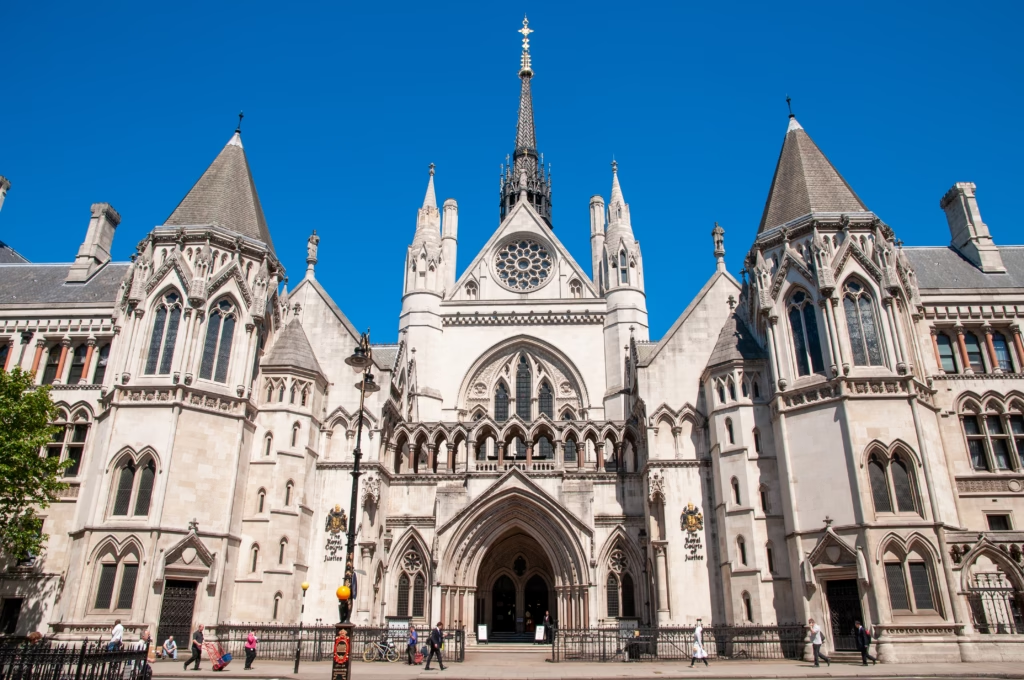
1,217 disputed probate cases were filed at the High Court in England and Wales in 2025, the highest annual total on record and a 12.7% rise on 2024. Probate caveats, formal applications used to pause an estate, topped 11,300 for the second consecutive year.
The figures reflect two trends: rising estate values, which raise the financial stakes of every family disagreement, and the growth of blended families, which 68% of estate professionals identify as the single biggest source of inheritance conflict.
The Robert Chung case illustrates what is at stake. Chung spent eight years fighting his siblings over a £600,000 estate. By the time the case concluded in April 2026, legal fees had consumed nearly half the estate’s value, leaving him facing a personal bill of £265,000.
A clearly drawn will, reviewed regularly, and paired with an open family conversation about intentions, removes the most common grounds for disputes. If your will hasn’t been reviewed in the last two years, or if your family circumstances have changed, now is a good time to act.
Want an LPA for the New Year? Apply Now
Over one million Lasting Powers of Attorney were registered with the Office of the Public Guardian in 2023-24, a 30% rise since 2019-20. The Powers of Attorney Act 2023 has introduced a fully digital application process with built-in identity verification. Despite this, registration currently takes around 20 weeks.
Twenty weeks from now is late January. If you want an LPA in place for the New Year, the window to apply is closing.
An LPA covers two areas: property and financial affairs, and health and welfare. Both require a separate application. Without one in place, if you lose capacity, no one can legally manage your finances or make decisions about your care, even a spouse or adult child, without going to the Court of Protection, which is significantly more time-consuming and expensive.
Find out more about Lasting Powers of Attorney on our website. If you do not yet have an LPA, or if the one you have is more than five years old, we would be glad to help you get it in order.
Five Inheritance Tax Exemptions Nobody Talks About
Most people know about the nil-rate band and the seven-year gifting rule. Far fewer know about any of the following:
1. The normal expenditure out of income exemption. If you make regular gifts from your income rather than from your capital, and the gifts do not affect your standard of living, they are completely exempt from inheritance tax with no seven-year waiting period. A grandparent who pays a grandchild’s school fees, or makes regular monthly transfers from pension income, can do so entirely outside the IHT calculation, provided the pattern is regular and documented. This is arguably the most powerful and most underused exemption in the tax code.
2. The small gifts exemption. You can give up to £250 to any number of people in a single tax year, completely free of inheritance tax. There is no limit on how many people receive a gift, as long as no individual receives more than £250. Christmas gifts to grandchildren, friends, or wider family can all qualify. N.B. The £250 small gifts exemption cannot be combined with the £3,000 annual exemption for the same person.
3. Wedding gift exemptions. Gifts made in consideration of marriage are exempt up to set limits: £5,000 per child, £2,500 per grandchild, and £1,000 to anyone else. The gift must be made before the wedding, not after.
4. The heritage asset exemption. As Jack Charlton’s case illustrates, items of national, historic, scientific or artistic significance can qualify for conditional exemption from inheritance tax under Section 30 of the Inheritance Tax Act 1984, in exchange for a commitment to allow reasonable public access. Military medals, rare books, vintage vehicles, and significant artworks have all qualified.
5. Gifts to political parties. Gifts to qualifying political parties are entirely exempt from inheritance tax, provided the party had at least two elected MPs at the last general election, or one MP and at least 150,000 votes. There is no upper limit.
None of these replaces a properly structured estate plan. But they’re available, and most people paying inheritance tax have never heard of them.

Your September Checklist
Christmas is seventeen weeks away. If you have been meaning to get your affairs in order before the end of the year, September is the moment to start.
- Cohabitation – if you are in an unmarried relationship, do not wait for legislation that will not arrive before 2028. A will and cohabitation agreement are available now.
- Pension nominations – with April 2027 seven months away, check that your nomination forms are current and reflect your intentions.
- Gifting – if you want to make use of this year’s annual exemption before April, or structure gifts to grandchildren efficiently, the earlier you take advice, the more options remain open.
- LPA – if you do not have one, apply now. At 20 weeks, you are already cutting it fine for the New Year.
- Your will – if anything has changed in the last two years, including relationships, property values, or family circumstances, your will may no longer say what you intend.
- The family conversation – if you have never discussed your wishes with the people who matter, September is a better moment than Christmas Day.
If anything here has prompted a question, we would be glad to hear from you. Have a question for next month’s newsletter? Send it our way.